
estrategia-data-driven4 min read
Digital Marketing Agency: How to Choose Without Regrets
What to look for in a digital marketing agency, what services it should offer, red flags and why conversion is the metric that matters most.

Hi, I'm Oriol and I got started in this world in 1998, when everything was still up for grabs. The era of modems, telephone calls and parents furious about skyrocketing phone bills.
All of that caught me somewhere between an agronomy degree I never finished and a nutrition degree I did. My final project was an online university for learning about nutrition. So that is how I started getting into the digital world.
After finishing my degree, I landed in some very early-stage online departments: first at Nestlé and then at Novartis. In the end, they were very large companies that could afford it at the time.
Later I joined Multiplica, a consultancy specialised in digital projects and a benchmark in Catalonia and Spain, where I became a Partner and Director of Consulting. Our focus has always been the same: making sure that users (those who buy the product or service) and clients (those who fund the project) are happy. How? By creating great user experiences based on seduction, not deception. We wanted to convert and make sure everyone was happy.
Finally, after many years and more than 250 projects, I decided to leave and go on to head the ecommerce division at Planeta, then the UX and Conversion area at Casa del Libro, and after a few years, I became CPO of Banco Sabadell. After the bank I landed at a book startup called Bookish. I spent a year there helping them and building an online culture. And, finally, Dogfy called me and here I am. I love dogs. I believe we are building a project where both dogs and owners are happy. And at the same time, the founders of this company are also happy because we are managing to sell more and better.
I have always worked on projects looking for them to be honest, well-made, appealing and to provide a certain pleasure when you use them… but focused on the numbers.
During my time at Multiplica, we worked on many projects, and really great ones. We worked with airlines such as Iberia, Vueling, Volotea and Binter, as well as in the tourism sector with Hoteles Meliá and Pullmantur. They are fun sectors with many business possibilities.
The same year we worked on Vueling, we won the Laus design award and also the award for the best e-commerce in Spain. So we combined what we were always looking for: something very well-made and aesthetically strong, along with something that worked and generated business.
I have always worked on projects looking for them to be honest, well-made, appealing and to provide a certain pleasure when you use them... but always focused on the numbers.
And, at a team level, I have always believed you need a small, very good and highly specialised team. I like having the best copywriter, the best UX, the best UI, the best front-end… Trustworthy people who love what they do. I think I have always been very lucky with that — at the end of the day, you are nothing on your own.
And, of course, I also think there is a crucial part: you have to trust your intuition and the numbers.
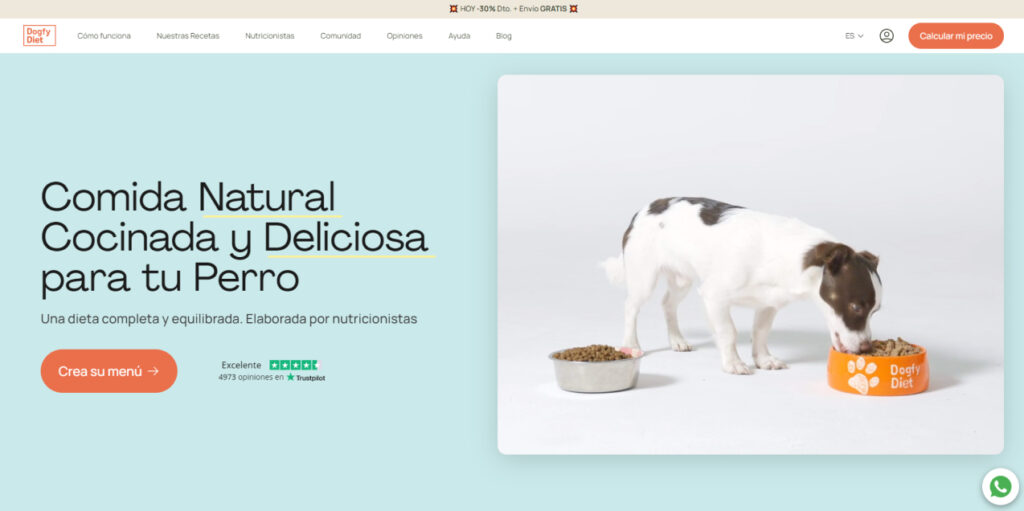 Dogfy Diet, Oriol Ibars's current challenge, is an e-commerce specialised in natural, fresh and healthy home-cooked food for dogs.
Regarding data analytics, I started out downloading server logs and processing them manually in Excel. Then some tools appeared that gave you very basic analytics from those logs.
Years later, somewhat more powerful measurement tools appeared, along with some books on how to apply all of this to an online business. Google then democratised everything with Analytics — you could do a lot with it and it integrated very well with the business vision and areas within our field.
However, after 20 years of working with product- and CRO-focused metrics, you realise that everything is becoming highly specialised in detail. Now, besides knowing how to ask the right question, you also need to know how to find the answer, and that is more complex. Current tools, like the new version of Analytics, have lost a bit of the user layer. In my opinion, the current landscape is somewhat of a case of "happy analyst, confused user".
The world has seen many disruptions: industry, computers, the Internet, AI, etc. But what we do (the WHAT) is constant. What is changing is the way we do it (the HOW).
I think what we are doing online is not magical at all. It is something we have been doing for thousands of years. After all, e-commerce is commerce. At one point, humans were trading shells, sticks... It is commerce — the only thing that has changed is that now it takes place in a different environment. In the online world you have to convey your value proposition very well, seduce users and treat your clients well so they come back. And this, in the end, is exactly what a local shop does too, if it does it well.
I also think it is very difficult to be asked to do something that has never been done before. The world has seen many disruptions: industry, computers, the Internet… I am sure there will also be a change in the banking sector in the future. Google might become a bank, or brands themselves might. But fundamentally, what we do (the WHAT) is constant. What is changing is the way we do it (the HOW).
For that reason, I do not see AI as a threat; rather, I think AI will help us do everything more efficiently. Some people may see, somewhat incidentally, how AI integrates into part (or a large part) of their work. However, that work will still exist — it will simply be carried out differently. Just as it once happened with travel agencies (now we book trips ourselves online) or taxi drivers (Uber and others).
It will depend on all of us how AI progresses, but I think it could bring us closer to a better civilisation (note that I am a science fiction lover and an optimist).
I like to imagine myself as a kind of digital craftsman. A bit old-fashioned, perhaps. A small "luthier", a "mestre d'aixa" who instead of building boats builds digital experiences. Anyone can build a boat… but not that specific boat my clients desire, made with care and crafted by hand. And analytics, together with my team, are the tools that help me craft with pixels.
Discover how Boost helped DogfyDiet turn data into results: DogfyDiet case study →
What to look for in a digital marketing agency, what services it should offer, red flags and why conversion is the metric that matters most.
Everything you need to know before hiring an SEM agency: services, pricing, real metrics and how to ensure every euro in ads generates a return.
What to expect from a social media agency, how to measure the real ROI of social media and why likes don't pay the bills.