

optimizacion-conversion5 min read
BNPL: Buy Now Pay Later for ecommerce
Deferred payment reduces cart abandonment by up to 20%. Discover how to implement BNPL in your store and when it actually makes sense.
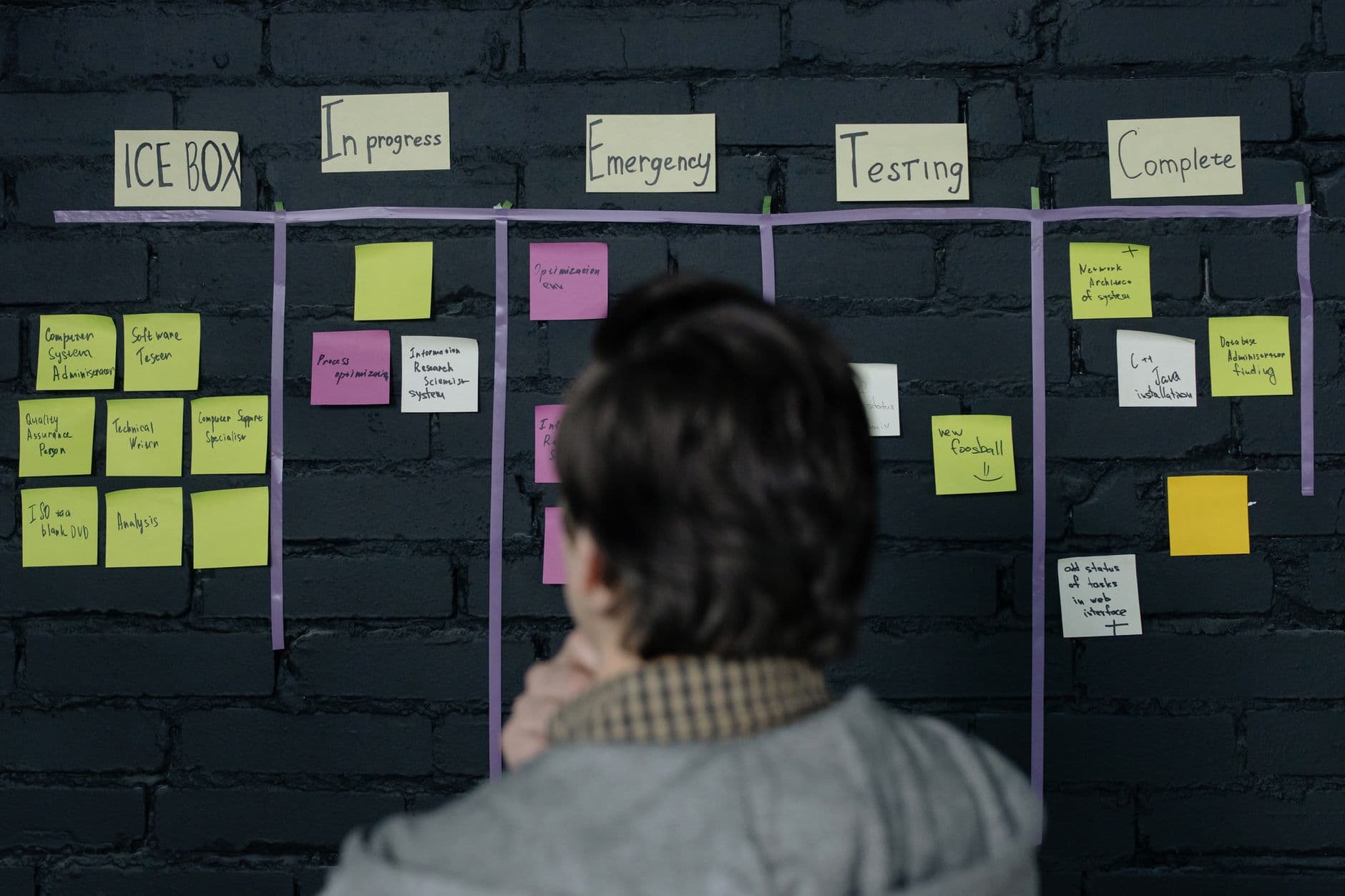
Agile methodology is a project management approach based on short work cycles, continuous iteration, and constant adaptation to change. It was born in the world of software development, but today it is applied in digital marketing, product design, CRO, and virtually any discipline that requires speed and flexibility.
The core concept is simple: instead of planning everything in detail from the start and executing for months before validating, Agile proposes dividing work into small increments, delivering value continuously, and adjusting direction based on actual results.
For marketing and digital optimisation teams, this means leaving behind rigid 12-month plans and adopting a model where every week or sprint produces concrete learnings and improvements.
In 2001, 17 software developers gathered in Utah (USA) and wrote the Agile Manifesto. It was not a framework or a specific methodology but a declaration of values that changed how project management was approached.
The four values of the Manifesto are:
1. Individuals and interactions over processes and tools. People and direct communication are more important than any tool or formal process. A motivated, well-communicating team will solve problems faster than one with the best tools but no communication.
2. Working software over comprehensive documentation. Translated to digital marketing: real results (tests launched, improvements measured, landing pages in production) over endless strategy documents nobody reads.
3. Customer collaboration over contract negotiation. In CRO, this means working side by side with the client, sharing data, iterating together, and making decisions based on evidence, not on what was signed 6 months ago.
4. Responding to change over following a plan. If data show that the initial hypothesis was wrong, the team pivots. It does not cling to the original plan out of pride or inertia.
Beyond the 4 values, the Agile Manifesto includes 12 principles that guide its practical application:
| Principle | Application in digital marketing |
|---|---|
| Satisfy the customer through early and continuous delivery | Launch tests and improvements every sprint, not wait until the end of the quarter |
| Welcome changing requirements, even late | Pivot the testing strategy if data call for it |
| Deliver working software frequently | Deploy changes to production every 1-2 weeks |
| Daily collaboration between business and development | Weekly meetings between CRO team and stakeholders |
| Build projects around motivated individuals | Cross-functional teams with autonomy to experiment |
| Face-to-face communication as the most efficient method | Standups and reviews instead of endless email chains |
| Working software as the primary measure of progress | Tests launched and results measured as the primary KPI |
| Sustainable development at a constant pace | Sustainable testing rhythm, without exhausting sprints |
| Continuous attention to technical excellence | Quality in the implementation of each test variant |
| Simplicity: maximise the work not done | Prioritise the tests with the highest potential impact |
| Self-organising teams | The CRO team decides what to test based on data |
| Regular reflection on how to be more effective | Retrospectives to improve the experimentation process |
Agile is a philosophy. Scrum, Kanban, and Lean are concrete frameworks that implement it. Each has its own rules, roles, and rituals.
Scrum is the most popular Agile framework. It organises work into fixed-duration sprints (usually 2 weeks) with clearly defined roles.
Scrum roles:
Scrum ceremonies:
Kanban has no sprints. Work flows continuously through a visual board with columns (To Do, In Progress, Done). The key to Kanban is WIP (Work in Progress) limits: each column has a maximum number of simultaneous tasks.
Kanban advantages for marketing teams:
Lean Agile focuses on eliminating everything that does not add value for the customer. In digital marketing, this means eliminating unnecessary meetings, reports nobody reads, approval processes that slow down execution, and any activity that does not directly contribute to improving results.
| Characteristic | Scrum | Kanban | Lean |
|---|---|---|---|
| Structure | Fixed sprints (1-4 weeks) | Continuous flow | Continuous improvement cycles |
| Roles | PO, Scrum Master, team | Does not define specific roles | Flexible depending on context |
| Planning | Sprint Planning at the start | Continuous prioritisation | Based on value stream |
| Priority changes | Only between sprints | At any time | At any time |
| Ideal for | Projects with clear objectives | Teams with reactive work | Process optimisation |
| Use in CRO | Structured testing programmes | Support + testing teams | Reducing time-to-test |
The backlog is the ordered list of everything the team could do. In digital marketing, it includes campaigns, content, A/B tests, UX improvements, technical optimisations, and any other planned action.
The key is to prioritise. Not all tasks have the same impact. Use a prioritisation framework like ICE (Impact, Confidence, Ease) or RICE (Reach, Impact, Confidence, Effort) to objectively order your backlog.
Two weeks is the most common and effective duration for marketing teams. It is enough time to complete significant tasks but short enough to maintain focus and urgency.
At the start of each sprint, the team selects the backlog tasks they can reasonably complete. It is essential to be realistic: better to commit to fewer tasks and complete them all than to promise too much and not deliver.
In small marketing teams (3-6 people), a 15-20 minute weekly standup is usually sufficient. The goal is to synchronise, detect blockers, and keep the team aligned.
At the end of each sprint, the team presents results to stakeholders (review) and reflects internally on the process (retrospective). The retrospective is where real continuous improvement happens: what worked, what did not, what to change.
Each sprint is an opportunity to learn and improve. If a content type does not work, pivot. If an acquisition channel shows better performance, allocate more budget. If the approval process takes too long, simplify it.
Conversion rate optimisation (CRO) is inherently an agile process. Each A/B test is an experiment with a hypothesis, execution, measurement, and learning. The CRO cycle follows exactly the iterative logic of the Agile Manifesto.
A mature CRO programme works exactly like a Scrum team:
CRO teams that adopt Agile launch more tests per quarter, learn faster, and accumulate improvements in a compounding fashion. If your competitor launches 3 tests per quarter and you launch 12, in one year you will have accumulated 48 learnings versus their 12. That difference translates directly into conversions, revenue, and competitive advantage.
At Boost, our optimisation programmes follow an agile model with 2-week sprints, an impact-prioritised backlog, and continuous retrospectives. This is what allows us to accumulate over 1,000 optimisation actions with an average 47.8% conversion increase per client.
The ICE framework is especially useful for prioritising CRO hypotheses within an agile approach:
| Factor | What it measures | Scale | Example |
|---|---|---|---|
| Impact | Potential effect on the target metric | 1-10 | Main CTA redesign: 9 |
| Confidence | Degree of certainty in the hypothesis | 1-10 | Based on heatmap + data: 8 |
| Ease | Effort needed to implement | 1-10 | Copy change: 9 (easy) |
The ICE Score is calculated by multiplying the three factors. Hypotheses with the highest score are executed first. This system prevents the team from spending entire sprints on low-impact tests.
Many teams adopt Agile because it sounds modern but continue making decisions based on opinions instead of data. Agile without a measurement culture is simply doing things faster, not doing the right things.
One-week sprints do not allow enough time to complete significant tasks. Four-week sprints lose urgency. Two weeks is the sweet spot for most marketing teams.
If the team accepts more work than it can handle, Agile becomes an endless list of incomplete tasks. WIP limits exist for a reason: to force the team to finish before starting something new.
If the retrospective becomes a formality where everyone says "all good," the opportunity for improvement is lost. The best retrospectives are honest, specific, and produce concrete actions.
Agile does not mean improvisation. It means adaptive planning. There is a backlog, there are priorities, there are clear objectives. What changes is the willingness to adjust the plan when reality (the data) demands it.
You do not need sophisticated tools to get started with Agile. A physical board with sticky notes can work perfectly for small teams. But when the team grows or works remotely, digital tools become necessary.
The most widely used tools in Agile marketing teams include Jira (the most comprehensive for Scrum), Trello (ideal for visual Kanban), Asana (a good balance between simplicity and functionality), ClickUp (highly configurable with multiple views), and Notion (flexible for teams combining documentation and management).
The tool is secondary. What matters is the process and the team's discipline to follow it.
Imagine a fashion e-commerce with a 1.8% conversion rate that wants to improve it. A traditional approach would be to do a lengthy analysis, create a detailed plan, and execute massive changes after 3 months of planning.
An Agile CRO approach would be different:
Sprint 1 (weeks 1-2): rapid data analysis. Identify the 3 pages with the greatest improvement potential. Formulate 10 hypotheses. Prioritise with ICE. Launch the first A/B test on the product page (more visible CTA, benefit-oriented copy).
Sprint 2 (weeks 3-4): while the first test accumulates data, analyse checkout session recordings. Identify friction points. Prepare the second test. Review preliminary results of test 1.
Sprint 3 (weeks 5-6): test 1 results with statistical significance. Variant B improves conversion by 12%. It is implemented as the winner. Test 2 is launched on the checkout (simplified form). New hypotheses are formulated based on the learnings.
In 6 weeks, the team has launched 2-3 tests, implemented at least one measurable improvement, and has an increasingly refined hypothesis backlog. In 6 months, it will have accumulated 12-15 tests and significant compounding improvements.
The data is clear: teams that adopt Agile methodologies produce more, learn faster, and adapt better to market changes. In a digital environment where trends, algorithms, and user behaviour change constantly, adaptability is not a luxury -- it is a necessity.
For CRO and digital marketing teams, Agile is not just a way of managing projects. It is the natural way of working when your goal is to continuously improve results based on evidence rather than assumptions.
The question is not whether your team should be Agile. The question is how many improvement opportunities you are losing each week that you are not.
Want to apply an Agile approach to your website optimisation? At Boost, we design CRO programmes based on rapid experimentation cycles with measurable results. Audit your website for free with Scan&Boost and discover your first improvement opportunities.
Adrià Vidal is the founder of Boost. +1,000 optimisation actions, +47.8% average conversion increase per client, +7.8M EUR in additional revenue generated.
Deferred payment reduces cart abandonment by up to 20%. Discover how to implement BNPL in your store and when it actually makes sense.
A well-designed popup at the moment of exit can recover between 15% and 30% of the revenue you were about to lose. Here's how to do it right.
CRO explained for executives: why to optimize before investing in traffic, which metrics to track, how to evaluate an agency and a sample ROI case.

