

optimizacion-conversion5 min read
BNPL: Buy Now Pay Later for ecommerce
Deferred payment reduces cart abandonment by up to 20%. Discover how to implement BNPL in your store and when it actually makes sense.
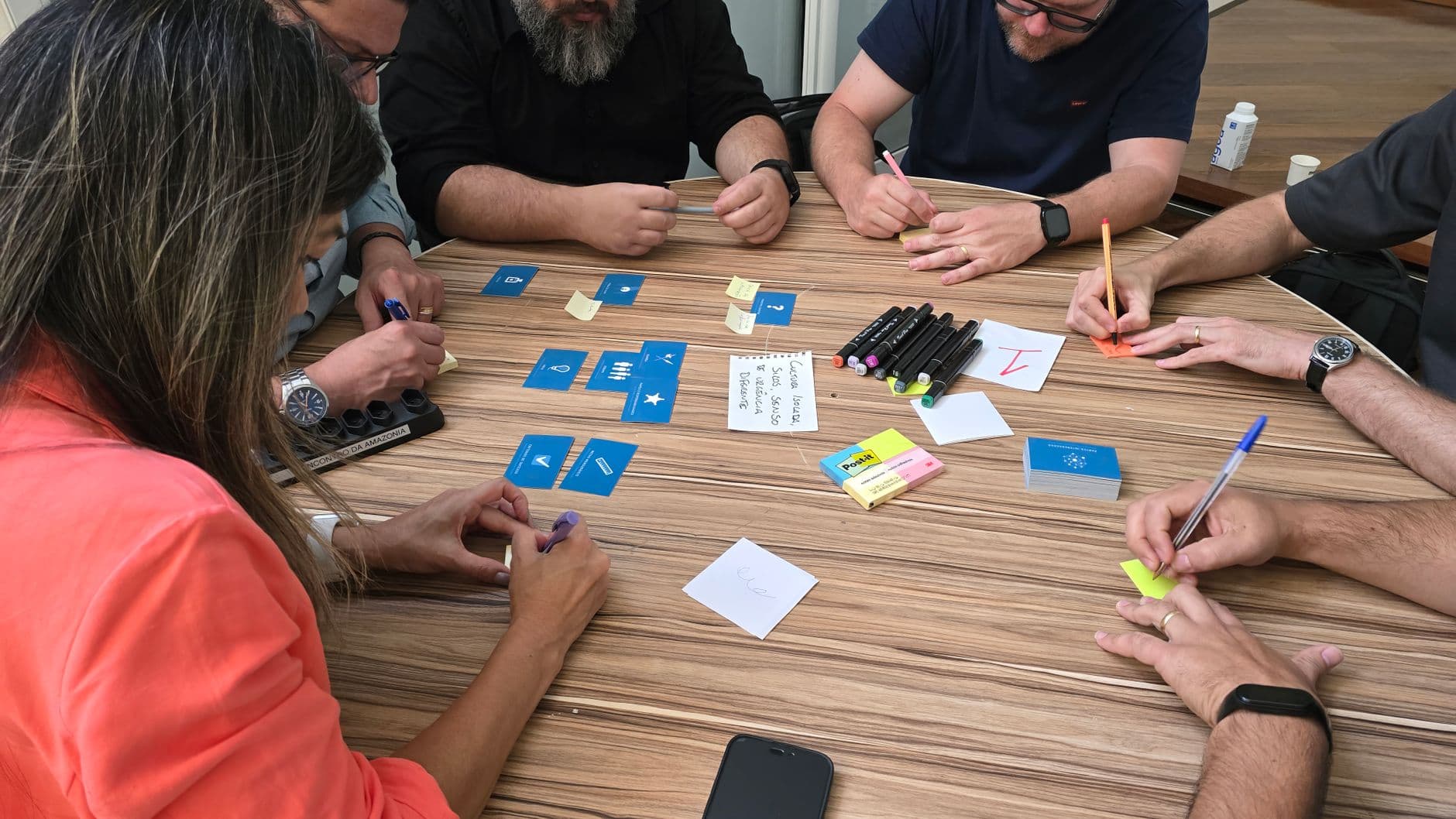
Design Thinking is a human-centred innovation process. It is not a theoretical framework or a trendy methodology: it is a structured way of solving complex problems by placing the user at the centre of every decision.
What makes Design Thinking relevant for digital business is not its creative approach but its results orientation. When you deeply understand your users -- their frustrations, motivations, and real behaviours -- you can design experiences that convert better.
In this guide, you will learn the 5 phases of Design Thinking, how to apply each one to your digital business, and why this methodology is one of the best tools for improving the conversion of your website or app.
Design Thinking is an innovation approach originally developed at the Stanford d.school and championed by the consultancy IDEO. It is built on three fundamental pillars: empathy with the user, iterative experimentation, and cross-disciplinary collaboration.
Unlike traditional product development methods -- which start from what the company wants to build -- Design Thinking starts from what the user actually needs. That inversion of the starting point radically changes the results.
One of the most common misunderstandings is thinking that Design Thinking is a methodology for design teams. In reality, its applications go much further: business strategy, product development, process optimisation, marketing, and of course, CRO (Conversion Rate Optimisation).
Companies like Airbnb, IBM, and Google use Design Thinking not only to design interfaces but to solve complex business problems, from redefining their value proposition to optimising the purchase experience.
The Design Thinking process is structured in five phases. They are not linear: you can (and should) iterate between them depending on what you discover.
| Phase | Objective | Key tools | Typical duration |
|---|---|---|---|
| 1. Empathise | Deeply understand the user | Interviews, observation, empathy map | 1-2 weeks |
| 2. Define | Frame the problem correctly | Point of View, How Might We, persona | 2-3 days |
| 3. Ideate | Generate as many solutions as possible | Brainstorming, SCAMPER, Crazy 8s | 1-2 days |
| 4. Prototype | Make ideas tangible | Wireframes, mockups, MVPs | 3-5 days |
| 5. Test | Validate with real users | Usability tests, A/B testing | 1-2 weeks |
Empathy is not assuming you know what your user wants. It is going out and observing, asking, and listening. This phase is the most important and the one most teams skip.
Research techniques for empathising:
The result of this phase is insights -- not opinions. Insights are findings based on qualitative data that reveal needs, frustrations, or motivations the user may not even know they had.
Einstein said that if he had one hour to solve a problem, he would spend 55 minutes understanding the problem and 5 minutes solving it. The definition phase is exactly that.
With the insights from the empathy phase, you define the problem precisely and actionably. The key tool here is the Point of View (POV), a statement that synthesises who your user is, what they need, and why.
POV format: "[User] needs [need] because [insight]."
Example: "First-time online shoppers need to feel secure at checkout because they are afraid of being scammed."
From that POV, you generate How Might We (HMW) questions -- "How might we...?" -- that open the solution space. "How might we make first-time buyers feel safe at checkout?"
Ideation is the phase where quantity matters more than quality. The goal is to generate the maximum number of ideas without judging them. The filter comes later.
Effective ideation techniques:
After ideating, you vote and prioritise. The impact/effort matrix is the most practical tool: classify each idea by its potential impact and implementation difficulty.
A prototype is not a finished product. It is the minimum version needed to test an idea. It can range from a paper sketch to an interactive wireframe in Figma.
Types of prototypes by fidelity:
The golden rule of prototyping is: build only what is necessary to learn. If you can validate an idea with a paper sketch, do not spend two weeks creating a prototype in Figma.
Testing is not asking your colleagues for their opinion. It is putting the prototype in front of real users, observing how they interact with it, and collecting actionable feedback.
Testing methods:
The result of testing is not "validating your idea." It is learning what works, what does not, and why. And with those learnings, iterating: going back to empathise, redefine, ideate, prototype, and test.
The connection between Design Thinking and CRO is direct. Both start from the same premise: to optimise the experience, you need to understand the user. The difference is that Design Thinking provides the qualitative framework and CRO provides the quantitative validation.
Every insight from the empathy phase can be transformed into a testable optimisation hypothesis. "Users do not complete checkout because they do not see shipping costs until the end" becomes an A/B test that shows shipping costs on the product page.
In CRO, prototyping means creating rapid test variants with tools like VWO or Optimizely before investing in development. You can test a new checkout design, a new value proposition, or a different CTA without touching a single line of code.
Design Thinking and CRO share the same principle: there is no perfect solution on the first try. There is a continuous improvement process based on data and iterative learnings. Each test generates insights that feed the next iteration.
Use Design Thinking to design new features, redesign existing flows, or launch new products. The process reduces the risk of building something nobody wants to use.
Apply the 5 phases to optimise the purchase journey: from the homepage to post-sale. Empathy with the buyer (what worries them, what holds them back, what motivates them) is the foundation for a checkout that converts.
Every landing page is a micro Design Thinking project. Define who it is for, what problem it solves, generate variants, prototype them, and test them. A conversion-optimised web design always starts from a deep understanding of the user.
Design Thinking is not limited to interfaces. You can use it to redefine your value proposition, explore new markets, design services, or solve operational problems. The methodology is the same: empathise, define, ideate, prototype, test.
The most serious and most frequent mistake. Assuming you already know the user is the recipe for building solutions nobody cares about. The empathy phase is not optional.
Design Thinking works because it forces you to generate multiple solutions before choosing one. If you stick with the first idea that sounds good, you are losing 80% of the process's value.
High-fidelity prototypes with weeks of work that are then never tested or discarded. Always start with the minimum fidelity needed to learn.
Design Thinking is not a linear process with a final result. It is a cycle. If you do not iterate after testing, you have stopped halfway.
Design Thinking is excellent for generating qualitative insights, but it needs to be complemented with quantitative data to validate that solutions work at scale. That is where A/B testing is essential.
Imagine a fashion e-commerce with a 1.2% mobile conversion rate (below the industry benchmark).
Empathise: interviews with 8 users reveal they cannot find their size quickly and distrust the photos because "they never look like reality."
Define: "Mobile fashion shoppers need to feel confident the garment will fit them because they cannot try it on."
Ideate: interactive size guide, photos of models with different body types, customer reviews with photos, prominent return policy.
Prototype: wireframe of the PDP (Product Detail Page) with the integrated size guide and social proof with customer photos.
Test: A/B test of the new PDP vs. the current one over 4 weeks. Result: +18% mobile conversion, +23% add-to-cart.
That +18% does not come from nowhere. It comes from having empathised with users, defined the right problem, and tested the solution with real data.
Design Thinking is not a fad: it is a proven way of solving complex problems by placing the user at the centre. In the digital context, applying Design Thinking to your product, e-commerce, or marketing strategy allows you to create experiences that are not only better for the user but also convert more.
The key is connecting Design Thinking's qualitative insights with CRO's quantitative validation. Empathise, define, ideate, prototype, test -- and repeat. That cycle is what separates companies that constantly improve from those that remain stagnant.
Want to apply Design Thinking to your website optimisation? At Boost, we combine user research with CRO to design experiences that convert. Discover our conversion optimisation services or analyse your website for free with Scan&Boost.
Adrià Vidal is the founder of Boost. +1,000 optimisation actions, +47.8% average conversion increase per client, +7.8M EUR in additional revenue generated.
Deferred payment reduces cart abandonment by up to 20%. Discover how to implement BNPL in your store and when it actually makes sense.
A well-designed popup at the moment of exit can recover between 15% and 30% of the revenue you were about to lose. Here's how to do it right.
CRO explained for executives: why to optimize before investing in traffic, which metrics to track, how to evaluate an agency and a sample ROI case.

